

Leading brands that work with us









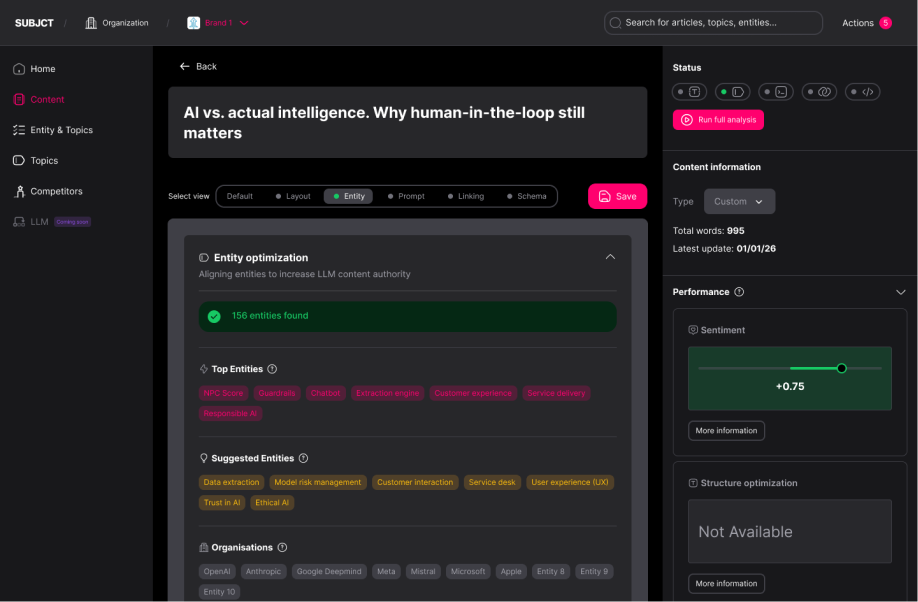
Entity Analysis & Strategy
Build the topical authority AI engines trust.
AI search platforms judge brands by the entities they cover, not keywords. SUBJCT maps every entity in your archive, benchmarks it against competitors, and shows exactly where your topical authority already stands.
.png)
Full archive mapping
Every organisation, person, product, place and event in your content identified and categorised automatically.
Competitor gap analysis
See exactly where competitors hold entity authority you don't, and where you're already ahead.
In-editor suggestions
Related entities surfaced as you write, so you build topical depth before you publish.
Semantic Internal Linking
Links implemented across your archive, automatically.
Internal links show AI search platforms how your content connects, but building them by hand across a large archive isn't realistic. SUBJCT finds the closest semantic matches and implements the link directly, not in a list for review.
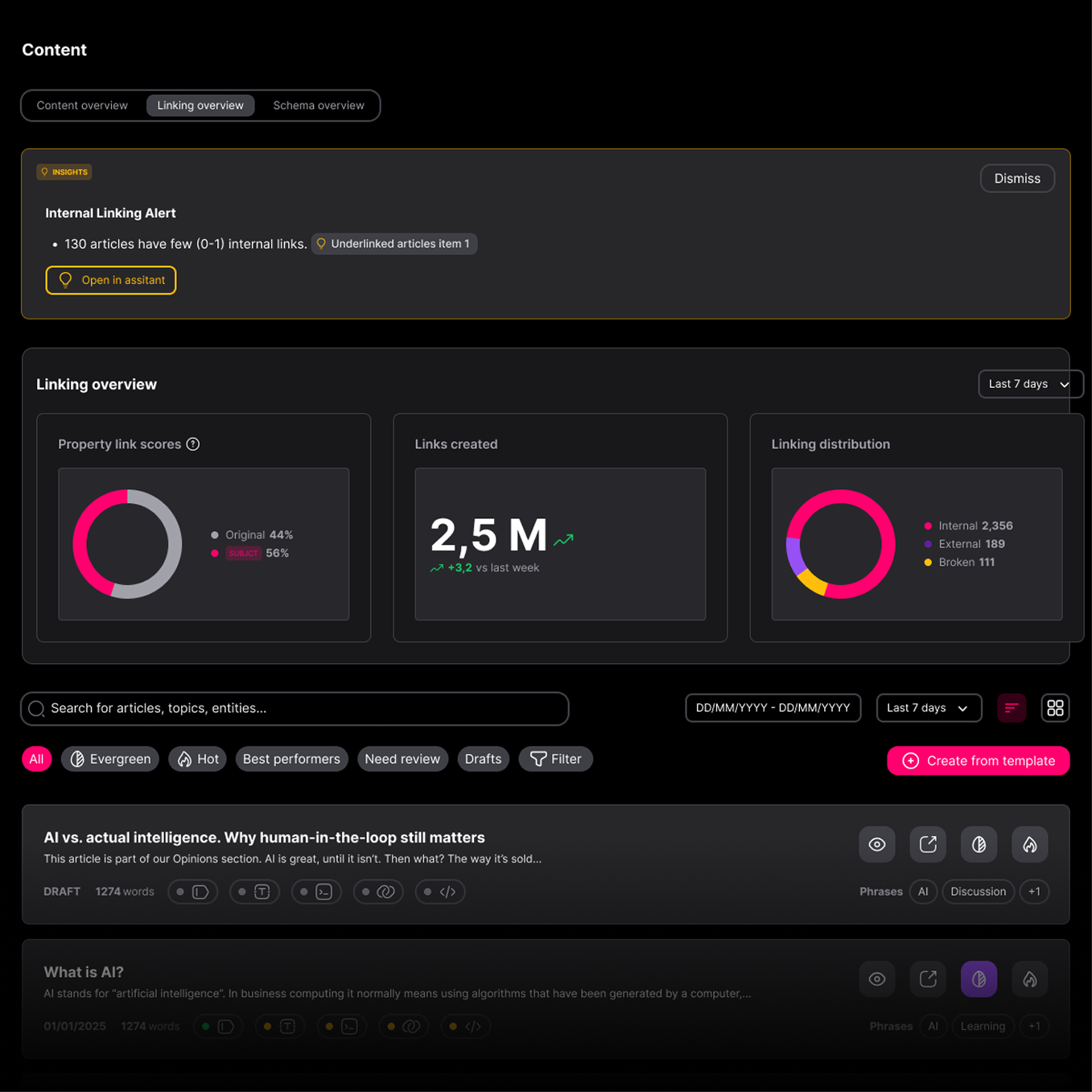
Two linking modes
Article-to-article linking builds topic clusters; entity linking connects each first mention to its topic page.
Editable, not fixed
Every automated link stays editable, and candidate matches wait separately for your review.
Archive-scale coverage
Related entities surfaced as you write, so you build topical depth before you publish.
Schema JSON-LD
A machine-readable data layer for your content.
AI search platforms need an unambiguous entity profile to cite content with confidence. SUBJCT generates entity-aware JSON-LD schema for every page, assigned contextually by content type, and links each entity to the Google Knowledge Graph.
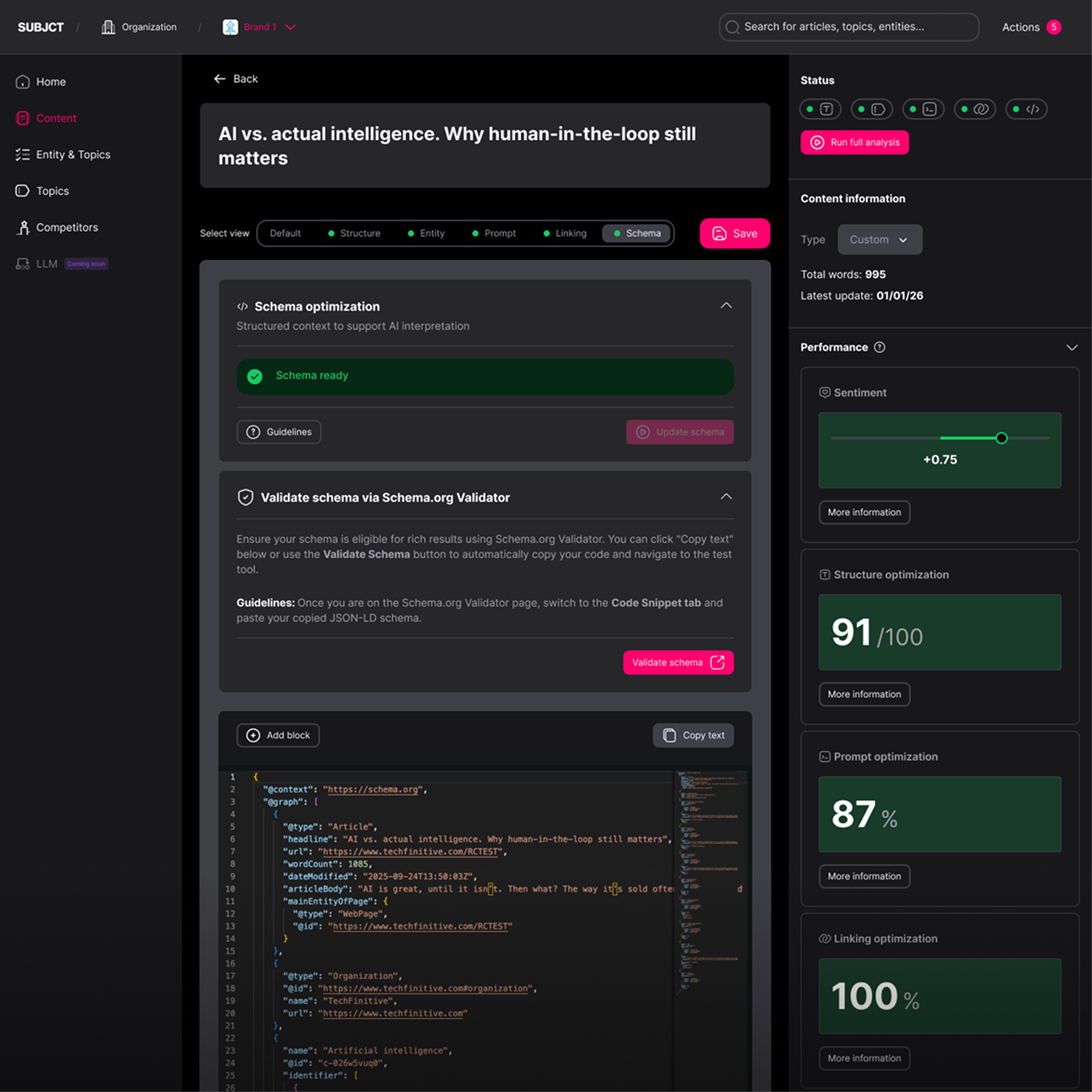
Generated for every page
No blanket templates, schema type assigned contextually, whether Article, FAQ, WebPage, HowTo or Product.
Knowledge Graph linked
Top entities from each article linked to the Google Knowledge Graph, removing ambiguity for AI engines.
Validated before publish
Related entities surfaced as you write, so you build topical depth before you publish.
Ready to build AI search optimisation into your stack?
Get in touch to find out more about our suite of content optimisation products built for AI Search.
.png)
Frequently asked questions
What is content optimisation for AI search, and how is it different from SEO?


Content optimisation for AI search is the practice of structuring, linking and marking up content so AI engines - ChatGPT, Google AI Overviews, Perplexity - can retrieve, understand and cite it with confidence. Traditional SEO is built around rankings, sessions and click-through rate on a search results page. AI search works differently: it retrieves chunks of content, resolves entities, and decides what to cite in an answer. SUBJCT is built around the signals that drive that outcome - entity coverage, internal link structure and schema - measured through citation share and inclusion rate rather than ranking position.
How does entity mapping actually build topical authority?
AI engines assess a brand's authority on a topic partly by how completely and consistently it covers the entities - organisations, people, products, places, events - connected to that topic. SUBJCT scans your full archive, identifies every entity present, and benchmarks that coverage against named competitors, so you can see precisely which entities you're missing and where you already lead. Closing those gaps is what builds the topical depth AI engines use to judge trust.
Does automated internal linking replace manual link-building, or just speed it up?
It replaces the manual process for archive-scale work. SUBJCT chunks your content, embeds it, and finds the closest semantic matches across your archive using cosine similarity, then implements the anchor text and the link directly in the content, rather than producing a list for someone to action page by page. Two modes run in parallel: article-to-article linking, which builds topic clusters, and entity linking, which connects the first mention of a named entity to its relevant topic page. Every link stays editable, and matches SUBJCT finds but doesn't automatically apply wait separately as candidates for your review.
What schema does SUBJCT generate, and does adding schema increase AI citations on its own?
SUBJCT generates entity-aware JSON-LD for every page, with the schema type - Article, FAQ, WebPage, HowTo, Product and others - assigned contextually based on content type, not applied as a single blanket template. The top entities in each article are linked to their Google Knowledge Graph identifiers, giving AI engines an unambiguous profile to resolve the content against. To be direct about what schema does and doesn't do: current published evidence doesn't show a reliable causal link between adding schema and AI citation uplift on its own. Its proven value is disambiguation, it's most useful for entities and brands an AI system doesn't already recognise with confidence.
Does this work across my existing content archive, or only on new content going forward?
Both. Entity mapping, internal linking and schema generation all run across an existing archive in a single pass. SUBJCT is built for teams with years of published content who can't realistically re-link or re-tag it by hand. The same features apply automatically to new content as you write it in the editor, so archive and pipeline stay consistent rather than diverging over time.
Do I need developer resources to implement this?
No. Entity analysis, linking and schema generation run inside the SUBJCT web application and editor without engineering input. For teams that want it embedded directly into their CMS or publishing pipeline, SUBJCT is also available via API, MCP Server and a WordPress plugin, but none of those are required to use the core solution.
How is this different from mass-producing templated content at scale?
It isn't content generation, and it doesn't template pages. SUBJCT optimises the structure, linking and machine-readable data around content your team has already written - the signals that determine whether that content is retrievable and citable. The editorial substance of each page is yours; SUBJCT doesn't produce or duplicate it, and each use case or case study built on the platform is written as a distinct page rather than a repeated template.

Still have questions?
Can’t find the answer you’re looking for? Please chat to our friendly team.
Get in touch
SUBJCT
Get in touch
Latest posts
Resources and insights for AI search
The latest industry news, interviews, technologies, and resources.



View all posts

Content Optimisation Built for AI search.