

Entity Analysis
Know Exactly Where Your Content Has Authority, And Where It Doesn't.
Entity Analysis maps every organisation, person, product, place and event in your archive - then benchmarks your coverage against competitors. Built for marketing teams and AI search specialists who need to know where their topical authority stands, not guess at it.
Leading brands that work with us









ENTITY ANALYSIS
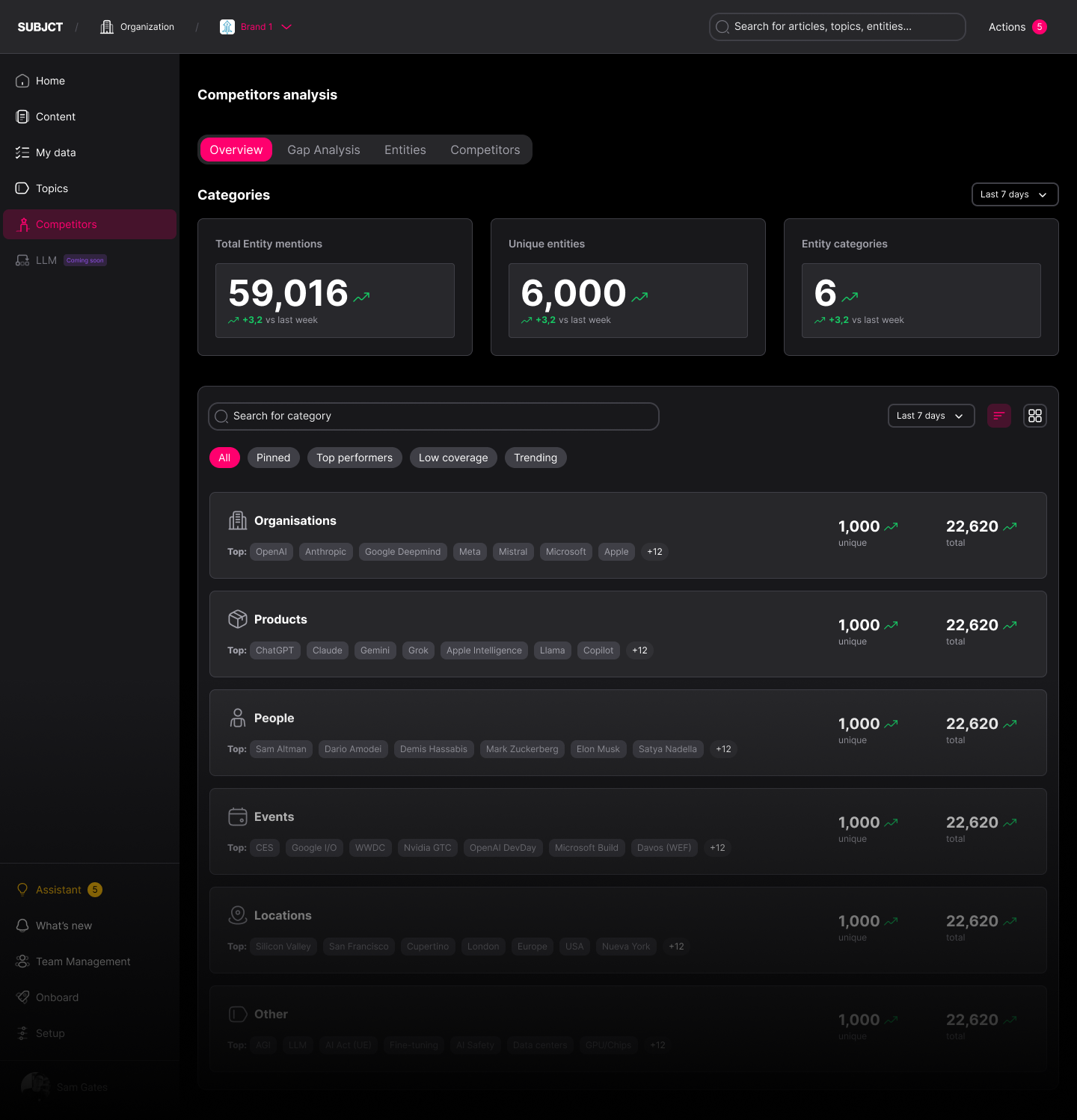
Entity coverage across your whole archive

Every entity in your content, mapped, counted, and grouped into organisations, people, products, places and events
Once your archive is ingested, SUBJCT identifies every entity it contains and breaks the results down by category, so you can see your topical footprint at a glance
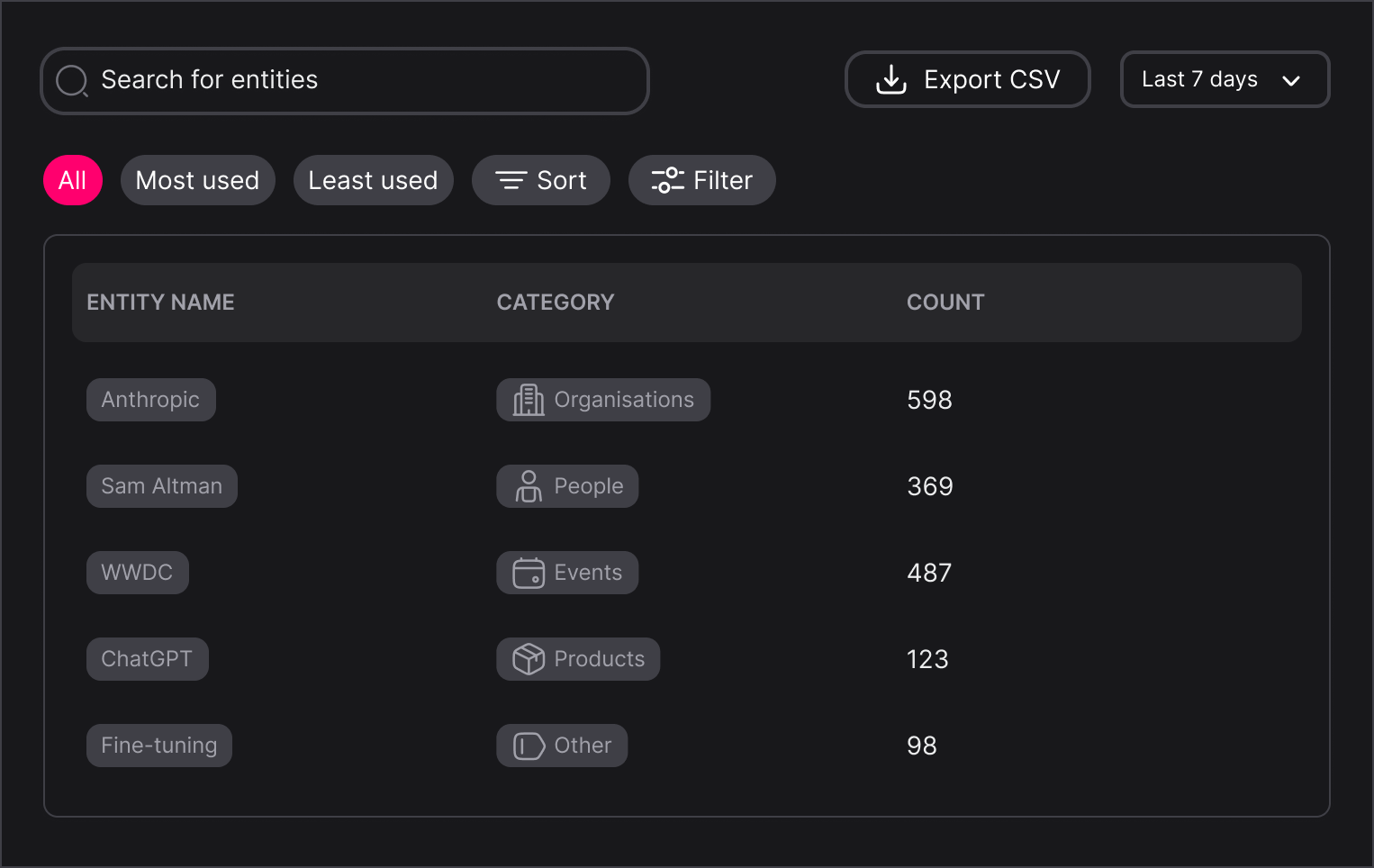
Click into any entity or category to review counts and source articles, export the full entity dataset as a CSV, and generate strategy reports
COMPETITOR ANALYSIS
Competitor gap analysis
Know exactly where competitors have authority you don't
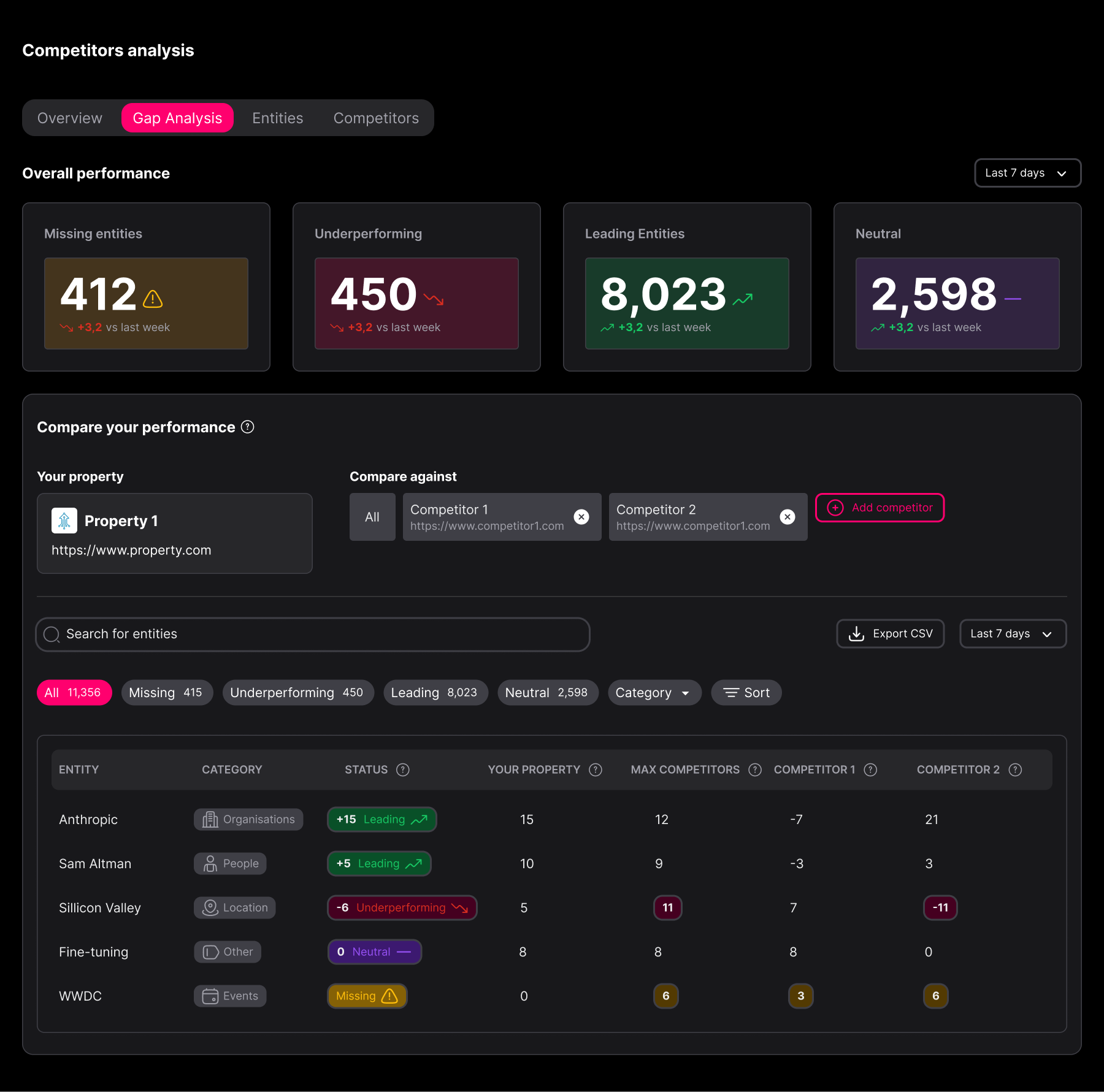
Add your competitors and SUBJCT analyses their content the same way it analyses yours, so gaps in your coverage stop being a guess
Run a Gap Analysis to see where you're weaker, stronger, or already authoritative
TOPICAL AUTHORITY
Entity suggestions inside the editor
Build topical authority as you write, not after
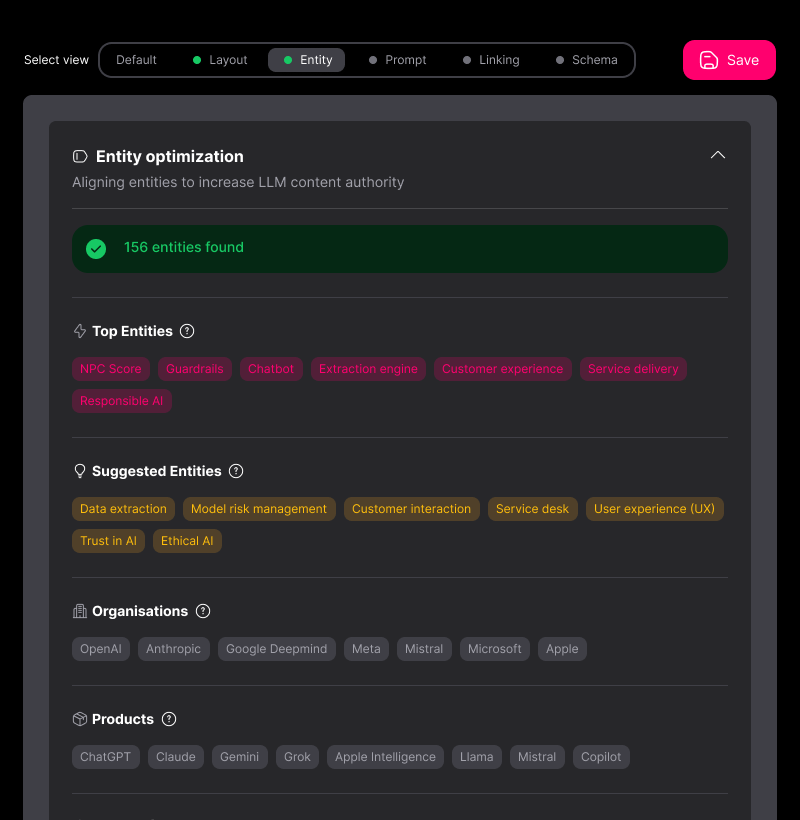
Entity Analysis lives inside the SUBJCT editor too. As you write, SUBJCT identifies the entities already present and suggests related ones you haven't covered
Related entities suggested based on your content's themes
Value Pillars
SUBJCT is the automated content optimisation platform for brand discovery in AI search.

Efficiencies
Other tools in this category identifies opportunities. SUBJCT acts on them. Links created, schema JSON-LD generated, entities tagged across your entire archive.

Integrations
API-first, with a Web App for configuration, a WordPress plugin for direct CMS integration, and an MCP server connecting SUBJCT to any MCP-compatible agent.

Custom Solutions
For publishers and brands managing bespoke integrations, large archives running into the hundreds of thousands of pages, or a migration that needs custom optimisation before go-live.
Frequently asked questions
What is entity analysis in AI search?


Entity analysis is the process of identifying the organisations, people, products, places and events referenced across a content archive, and mapping how they relate to one another. AI search engines assess content by the entities it covers and how authoritative it is on them, not just by keywords. Entity analysis shows you what your content already covers, what it's missing, and where your topical authority is strongest.
How does SUBJCT's Entity Analysis feature work?
SUBJCT analyses your ingested content archive and identifies every entity it contains, categorised into organisations, people, products, places and events. You can view entity counts by category, click into any entity to see where it appears across your archive, and export the full dataset as a CSV. The same analysis also runs live inside the editor, surfacing the top entities in an article as you write and suggesting related ones you haven't covered.
Does Entity Analysis compare my content to competitors?
Yes. You can add competitors, either manually or via SUBJCT's suggested-competitor feature, and SUBJCT analyses their content the same way it analyses yours. A Gap Analysis then shows where you have stronger or weaker entity coverage relative to each competitor, and where you already hold topical authority. This turns competitive positioning into a data-backed view rather than a guess.
What categories of entities does SUBJCT identify?
SUBJCT identifies six entity categories: organisations, people, products, places, events and ‘other’. Each category can be filtered and sorted by entity count or usage, so you can see at a glance where your archive is entity-rich and where coverage is thin.
Does Entity Analysis require my content to be ingested first?
Yes. Entity Analysis runs on content that has been ingested into SUBJCT via the Configuration settings by URL, sitemap, or a list of URLs uploaded as a spreadsheet. Once ingested, the full archive is analysed in a single pass, not sampled.
How is Entity Analysis connected to Schema and internal linking?
Entity Analysis is the foundation both features build on. The entities identified in an article are the same entities embedded in SUBJCT's JSON-LD schema and linked to the Google Knowledge Graph. They're also what SUBJCT's internal linking uses to connect entity mentions to relevant topic pages the first time they appear in an article. Entity coverage, schema and linking all draw from the same underlying analysis.
Can I export Entity Analysis data?
Yes. Entity counts and coverage data can be exported as a CSV for reporting, further analysis, or sharing outside the platform. You can also generate strategy reports based on your specific data.
Who uses Entity Analysis, marketers or SEO/GEO specialists?
Both. Marketing teams use it to understand where their brand's topical authority stands and where legacy content is underutilised. Technical SEOs and content teams use it to prioritise which entities and topics to build out next, and to validate that automated tagging and linking are targeting the right entities.

Still have questions?
Can’t find the answer you’re looking for? Please chat to our friendly team.
Get in touch
SUBJCT
Get in touch
Latest posts
Resources and insights for AI search
The latest industry news, interviews, technologies, and resources.



View all posts

Content Optimisation Built for AI search.